
Why You Have To Play All Twelve Months Of The IPO Calendar

Why You Have To Play All Twelve Months Of The IPO Calendar
In March 2025 not a single mainboard IPO listed. In October 2025, seventeen did. Any allotment plan built on a quarter is not a plan — it is a coin toss with extra steps. Part One is the arithmetic. Part Two is the calendar.
The previous piece settled the odds: allotment is a draw, and in the big HNI category it converts roughly once in ten applications over a full cycle. This one is about what you actually do with that number.
It comes in two parts because the problem has two halves. One is arithmetic and one is the calendar. People who solve only the first still give up by March — and as you will see shortly, March is precisely the month that will make them give up.
PART ONE: The Arithmetic — Applications Are The Only Thing You Control
One number is fixed. The other is yours.
An allotment outcome has two inputs: the probability of a single application converting, and the number of applications you make.
The first is fixed by the issue — its size, the depth of demand in your category, the allotment rules. No broker, no relationship and no clever timing moves it. The second is entirely yours, and because probability compounds across independent attempts, a variable you fully control turns out to be enough.
You cannot improve the odds on any one IPO. You can make the odds of at least one allotment across a year approach certainty. Only the second problem is solvable — so stop working on the first.
What the compounding looks like
Working off the ten per cent blended conversion for big HNI from our backtest of 400-plus issues:
Those totals are simply the number of issues you apply to multiplied by the number of PANs applying to each. Thirty issues with one PAN is thirty applications. Thirty issues with four PANs is 120. Same calendar, same research, same discipline, four times the result.
That is why we treat four PANs as a floor rather than an optimisation. It is the point at which a year stops being hopeful and starts producing a countable number of allotments.
Get the category right before adding PANs
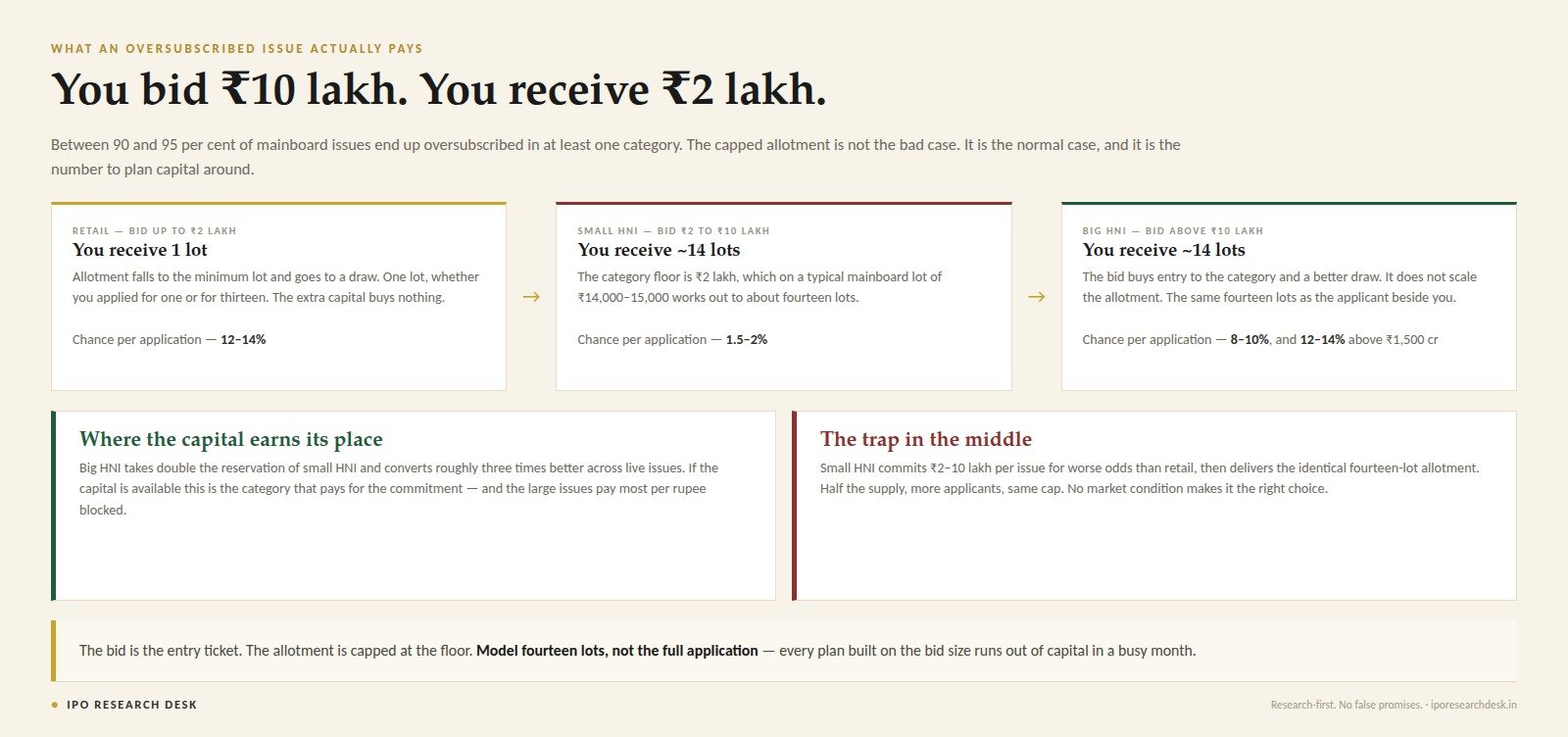
The large-issue effect is worth planning the year around. Conversion improves materially above ₹1,500 crore, so when capital is the binding constraint, the big issues are where a big HNI application earns the most per rupee blocked.
Three rules that keep the maths honest
— One application per PAN per category per issue. A duplicate under the same PAN gets both rejected - that turns an entry into a negative.
— Every PAN is a real, separate person with their own demat account and their own bank account. A household with four adults has four applicants. Entirely ordinary, and it is the whole basis of the compounding.
— Every application is funded from that person's own account and own money. An application in someone else's name backed by your capital is not a workaround. Do not build a system on it.
And the constraint nobody raises early enough: four big HNI applications means over ₹40 lakh blocked per issue. The money is blocked rather than spent, it keeps earning in the applicant's own account, and it is released within days - but it has to actually be there on the dates the issue is open. In a busy month, three issues will overlap. Work out the peak requirement before committing to a PAN count, not after.
PART TWO: The Calendar — Why Twelve Months Is The Only Honest Unit
The IPO calendar is not a calendar. It is a monsoon.
Here is the part that decides everything, and almost nobody looks at it before deciding whether the approach works.
IPOs do not arrive evenly. They arrive in bursts, separated by stretches where nothing lists at all. This is every mainboard listing of the last four years, month by month, against the number we put an APPLY call on.
Read the March and April columns. In 2025, across those two months together, not one mainboard IPO listed. Zero. In 2023, the first six months of the year produced five issues in total.
Now read July through December of the same years. Thirteen, sixteen, sixteen, seventeen, twelve, ten in 2025 alone.
2023, fifty-one of the year's fifty-six mainboard issues arrived after June. An investor who judged the approach on January to June that year saw five issues and concluded nothing works. The year they walked away from went on to deliver ten times what they had seen.
This is the whole argument for twelve months
People do not quit because the odds are bad. They quit because they started in a quiet stretch and mistook it for the norm.
Start in February 2025 and apply diligently through May. That is four months of commitment, capital kept ready, research read — against seven issues, of which three cleared our filter. Three applications in four months. At a ten per cent conversion, the overwhelmingly likely outcome is nothing at all. Quit there and you exit two months before a stretch that produced sixty-two issues in four months.
Your hit rate did not fail. You simply never had enough attempts for it to show up. That is the difference between a bad system and a small sample, and it is the single most expensive confusion in this business.
You cannot get twelve allotments out of three applications. The plan does not fail in the quiet months — it is simply not being run in them.
The filter is the other half of the discipline
Look again at the second number in each cell. It is always smaller, and the gap is the point.
Across 2023 to 2026 to date, 285 mainboard issues listed. We put an APPLY call on 198 of them. Eighty-seven issues were deliberately left alone — the weak, the over-priced, the over-hyped.
The clearest case is February to April 2026: sixteen issues listed and we recommended none of them. Three months, nothing. Anybody assessing the desk on that quarter would conclude we had stopped working. What actually happened is that the filter did its job, and July 2026 then produced thirteen issues with eight APPLY calls.
So the rule has an order, and it only works in one direction. Apply the research filter first. Then apply to every single issue that clears it, with every PAN you have. Volume within a filter. Never volume instead of one.
What a year of the filter actually delivered
Abstract probabilities are easy to argue with, so here is the concrete version. These are the APPLY calls where the big HNI allotment probability was above ten per cent per PAN - issues that were both recommended and genuinely securable.
Two things to take from that table. Roughly four out of five of these issues listed above their issue price, which is what the filter is for. And the expected allotment count is per PAN, from this subset only - before counting the APPLY calls that fell below the ten per cent cut-off, and before a second or third PAN is added.
Put four PANs behind CY2025's twenty-three issues and the arithmetic points to roughly twenty-eight expected allotments from that group alone. Which is a very different proposition from the one held by the person who applied to four IPOs in a quiet March and gave up.
High allotment odds and a positive listing gain in the same row is the sweet spot - an issue that was both easy to secure and worth securing. Those rows are what a year is built out of. They are not evenly distributed across it.
Keep your own scorecard
One sheet, one row per application. Issue name and size, category, PAN used, lots applied for, capital blocked, final category-wise subscription, allotted or not, and the listing outcome against issue price.
Twelve months of that gives you your own conversion rate instead of a borrowed one, tells you which issue sizes are actually paying for you, and gives you something to look at during a dry spell that is more reliable than your memory of it. Our own base file began as exactly this - a spreadsheet, maintained without a single exception.
What to expect, stated plainly
Four PANs, big HNI, applying to every issue that clears the filter across a full twelve months. In an active year that is roughly 120 applications and somewhere around twelve allotments - call it eight to fourteen, because a year is still a small sample.
Most of those allotments will be about fourteen lots, because nine issues in ten are oversubscribed and allotment collapses to the floor. Some months will produce three. March might produce none, because in March there may be nothing to apply to.
And the caveat that outranks all of it: an allotment is an entry, not a profit. Twelve allotments in issues that list below their price band is twelve losses efficiently acquired. Everything in Part One maximises entries into the issues you have already decided are worth entering. It says nothing about which ones those are - which is why the filter comes first, always.
And the part the tables do not capture
Sometimes the allotment lands in the one issue you nearly skipped. Sometimes three convert in a month the model said would produce one. Cricket has the same texture - the dropped catch on nine, the umpire's benefit of the doubt. Ask any player and they will tell you those moments made careers.
Call it luck, timing, or the return on how you have conducted yourself. The practical conclusion is the same whichever word you use: none of it reaches a batsman sitting in the pavilion. Four PANs across thirty issues is 120 occasions on which something good can happen to you. One PAN across five issues in a quiet March is five.
The playbook, in one place
None of this makes an allotment certain in any given issue, and nothing here should be read as a promise that it will be. It makes the year predictable. That is the only thing actually on offer, and it is worth more than the certainty nobody can sell you.
DISCLAIMER
The analysis presented herein is based on publicly available information and data as of the date of publication. This content is published for general information and investor education only and does not constitute investment advice or a recommendation to buy or sell any security. Investors should conduct their own due diligence before making investment decisions. Past performance is not indicative of future results and no guarantee of future performance is offered or implied. The publisher does not guarantee the accuracy, completeness, or timeliness of the information provided. Investment in IPOs and equity markets involves substantial risk, including the risk of loss of principal. Market conditions, company performance, regulatory changes, and macroeconomic factors can significantly impact investment outcomes.