
About Us
We Underwrite Decisions. We Don't Trade Whispers.
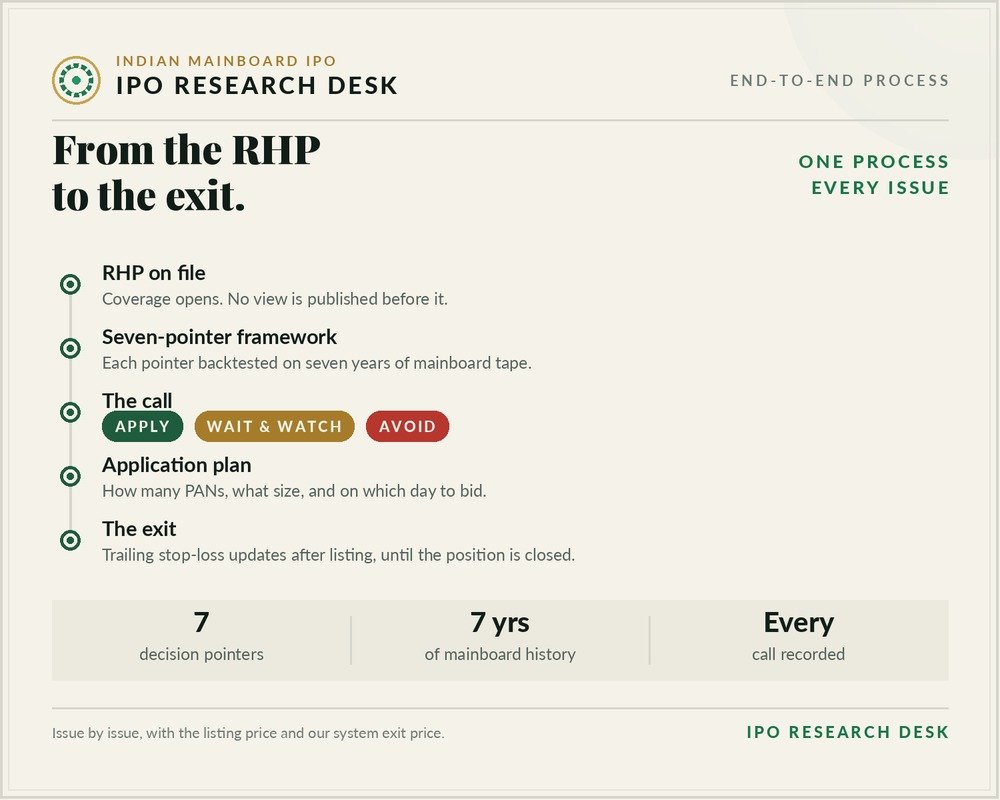
IPO Research Desk is a mainboard IPO research and advisory practice for Indian investors. We exist for one reason: to replace grey-market chatter and gut feel with a repeatable, research-led process — and to run that process end-to-end for the families we work with, from the first APPLY / AVOID call all the way through to the exit.
We are not a tip channel. We do not sell "sure-shot" listings or forward GMP screenshots. Every call we make is the output of a seven-pointer decision framework, each pointer backtested on seven years of mainboard history, and every call is recorded — issue by issue, with its listing price and our system exit price — so the work can be checked, not just believed.
Research First. GMP Last.
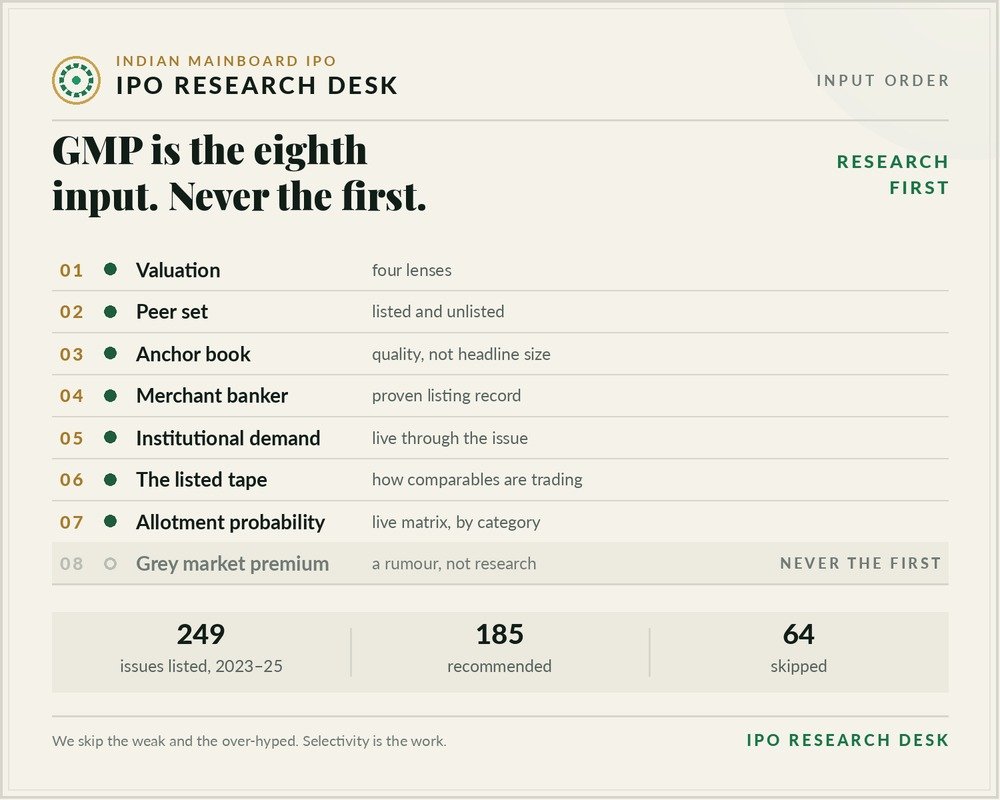
The Grey Market Premium is the market's mood compressed into a single number. It is a rumour, not research. So we build our view from the fundamentals up — valuation across four lenses, listed and unlisted peer comparison, the anchor book, the merchant banker's proven record, live institutional demand, the listed tape, and a live allotment-probability matrix. GMP, if we look at it at all, is the eighth input, never the first.
That discipline runs into how we are paid. Our advisory fee is fixed — a flat annual consultancy fee, not a performance-linked or profit-share charge. We earn the same whether the year is strong or subdued, which keeps our calls honest. We are incentivised to protect a family with an AVOID call, not to manufacture volume. Across 2023–25, of 249 mainboard issues that listed, we recommended just 185 — we skip the weak and the over-hyped, and that selectivity is where a large part of the value is created.
The Full Desk, End-to-End.
We run three things for every family we work with.
The Research
A seven-pointer decision framework, backtested over seven years, producing a clear APPLY or AVOID on every mainboard issue — never a maybe.
The Execution
Onboarding, funding maps, pre-filled ASBA forms or step-by-step videos for 11 banks, applications coordinated across the family's PANs, and a proprietary 2–5 day exit on every allotment. The family does not have to figure out the mechanics alone.
The Cost Edge
A 1-on-1 consultation that maps where a family's capital is sitting and funds the IPO calendar from idle or under-earning money — savings, FDs, bonds, unused OD/CC limits, or long-term holdings pledged (not sold) via Loan-Against-Securities. For business families the net funding cost can approach zero, and no existing holding has to be sold.
Measured, Not Claimed.
We hold ourselves to a live, issue-by-issue record rather than testimonials. The desk adds value in two measurable layers: selection — our APPLY calls beat the average of every issue that listed — and exit — our 2–5 day strategy beats a naïve listing-day sale. Blended across 2023-25, that is a total alpha of roughly +10.8% over an investor who simply bought the average issue and sold on listing day: +8.2% in 2023, +11.8% in 2024 and +9.5% in 2025.
Built for the BHNI Family Book.
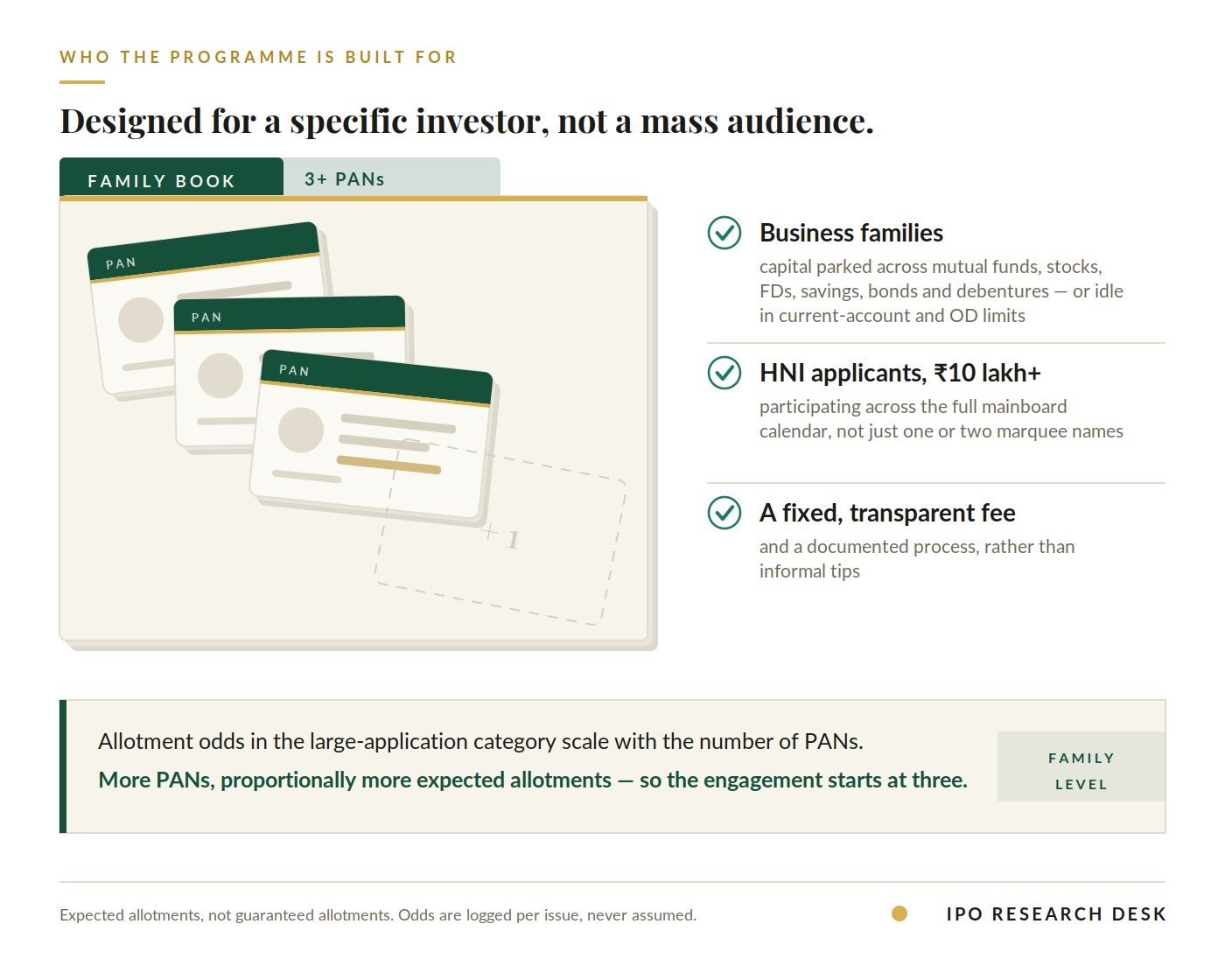
The programme is designed for a specific investor, not a mass audience.
- Business families with capital parked across mutual funds, stocks, FDs, savings, bonds and debentures — or idle in business current-account and overdraft limits.
- HNI (₹10 lakh+) applicants who want to participate across the full mainboard calendar, not just one or two marquee names.
- Investors who value a fixed, transparent fee and a documented process over informal tips.
Because allotment odds in the large-application category scale with the number of PANs, the engagement is built around a family book of three or more PANs — more PANs, proportionally more expected allotments.
A Fixed Fee, Deliberately.
Our advisory fee is ₹27,000 per PAN per year — fixed, not performance-linked — charged for the full 12-month research and application cycle regardless of outcome. Families begin with a 1-month free trial, onboard with three or more PANs, and those with four or more receive our exit-strategy plan (worth ₹25,000) free. The engagement also carries a structured refund assurance when the family follows the calendar and applies to 85–95% of recommended IPOs across the prescribed PANs. The client's upside from allotments and the exit is entirely theirs to keep.
DISCLAIMER
The analysis and figures presented are based on publicly available information and the desk's own record, as of the date of publication, and are illustrative. Investors should conduct their own due diligence before making investment decisions. Past performance is not indicative of future results. Investment in IPOs and equity markets involves substantial risk, including the risk of loss of principal.