
Why Bother With IPOs At All — And Where The Money Actually Comes From

Why Bother With IPOs At All — And Where The Money Actually Comes From
Everybody talks about IPO gains. Very few people can explain where those gains actually come from, or why they show up in some issues and go missing in others. This is the plain-English version.
An IPO, stripped of the noise
A company that needs money has three options. Borrow it, earn it, or sell a piece of itself. An IPO is the third option, done in public for the first time.
Two very different things happen inside most Indian mainboard IPOs, and it matters a great deal which one dominates. In a fresh issue, new shares are created and the cash goes into the company — to repay debt, build a plant, fund working capital, buy equipment. In an Offer for Sale, existing shareholders sell their own shares to you. Promoters, private equity funds, early backers. That money never touches the company. It lands in the seller's bank account.
Most issues are a blend of the two. The blend tells you something. When three-quarters of an issue is an Offer for Sale, the honest reading is that the people who understand the business best have decided this price is a good one to sell at. That does not automatically make it a bad investment. It does mean you should ask harder questions before you write the cheque.
Read the split before you read anything else. Fresh issue money builds the business. Offer for Sale money buys somebody a farmhouse. Both are legal. Only one of them is working for you.
Why an ordinary investor should care
Three reasons hold up under scrutiny.
The first is access. A number of the better businesses in India stay private for ten or fifteen years, funded by institutions you cannot invest alongside. The IPO is the first moment an outside investor can own the thing at all. If you liked a company as a customer and could never own it as a shareholder, this is the door opening.
The second is price discovery in your favour, occasionally. An issuer wants the book to be covered and wants a healthy first day. That creates a mild incentive to leave something on the table. It does not always happen, and in hot markets it stops happening entirely, but the incentive is real and it is structural.
The third is that a primary market allotment is one of the few places where a small investor and a large one buy at exactly the same price on exactly the same day. In the secondary market, size buys you better execution. In an IPO, everybody in the retail category pays the same rupee figure.
There is a fourth reason people never say out loud, which is that IPOs are interesting. That is a bad reason to invest and a common one.
Where the money actually comes from: two entirely different games
This is the part that gets muddled. There are two ways to profit from an IPO, they are driven by completely different forces, and mixing them up is how most people lose money.
betting on
return
track
rate
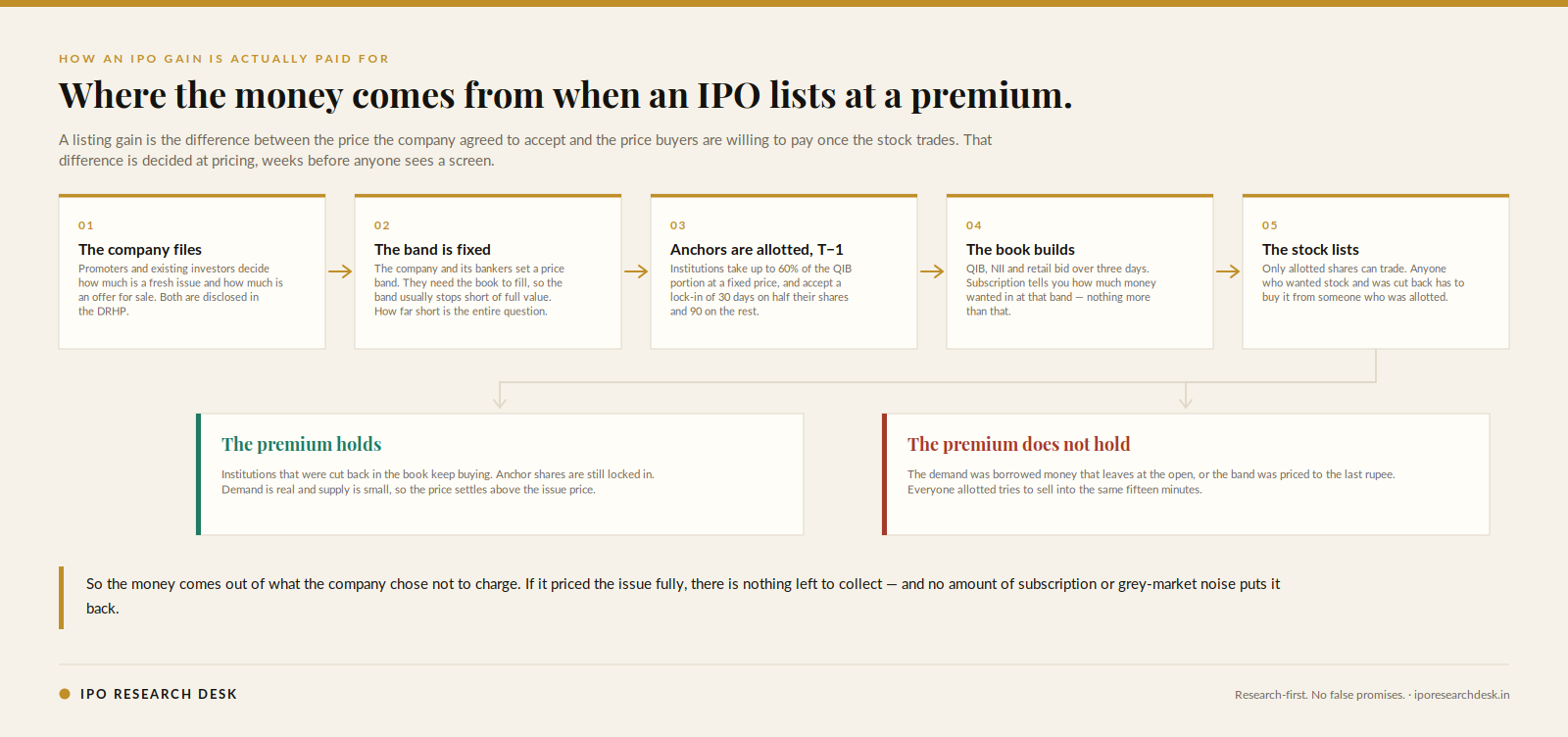
The listing game is a supply-and-demand trade. On the day a company lists, a fixed quantity of shares meets whatever demand exists that morning. If the issue was oversubscribed many times over, a large pool of investors wanted shares and did not get them. Some of them buy on the open market instead. That is the mechanism behind a listing pop. It has almost nothing to do with whether the company is any good.
The ownership game is ordinary equity investing that happens to start on listing day. Here the IPO is just an entry point. What matters afterwards is whether earnings grow. A company can list flat and still triple over four years. A company can pop thirty per cent on day one and spend the next three years below its issue price. Both happen every year, in every market.
You can play either. What you cannot do is enter for a listing pop, watch it fail, and then decide you were a long-term investor all along. That is not a strategy. That is a story you tell yourself to avoid booking a loss.
What realistic looks like
A grounded set of expectations, because the internet will not give you one.
In a strong market, a well-priced issue with genuine institutional demand can list up ten to thirty per cent. In a flat market, the same issue might list up three per cent, or open flat and drift. In a weak market, good companies list below their issue price and stay there for months. The company did not change. The mood did.
Across any full cycle, a meaningful share of mainboard IPOs trade below issue price within a year of listing. That is not a scandal. It is what happens when issuers get to choose the timing of the sale and the price of the sale. They will pick the moment that suits them, not you.
The seller picks the date and the price. That single sentence explains most of what is unusual about the primary market.
Which is why size matters more than anybody admits. If you are applying with one lot, the absolute rupee outcome of a listing gain is small — a fifteen per cent pop on a fifteen thousand rupee lot is roughly two thousand rupees before costs. Worth having. Not worth building a plan around. The people for whom listing gains are a serious business are applying in size, in the larger categories, with a proper view on demand.
So who should actually be doing this?
If you have a demat account, some spare capital, and you can tolerate an application not converting into an allotment, applying to selectively chosen IPOs is a reasonable use of money. Treat it as an occasional opportunity rather than a monthly ritual.
If you are borrowing to apply, doing it in every issue that opens, or sizing positions off a number you saw on a message forwarded to you, the mathematics is against you and it will find you eventually.
And if what you actually want is to own a good business for a decade, the IPO date is not sacred. You can buy the company six months after listing, with two quarters of public results in hand and no allotment lottery involved. Sometimes cheaper. Frequently with far better information.
IPOs are not a separate asset class with special rules. They are equity, sold by somebody who wants to sell, on a date that suits them, at a price they proposed. Everything reasonable about IPO investing follows from taking that sentence seriously.
Do the work on the business. Understand which of the two games you are playing before you apply, not after. And accept that some issues deserve a pass, which is a decision, not a missed opportunity.
DISCLAIMER
The analysis presented herein is based on publicly available information and data as of the date of publication. This content is published for general information and investor education only and does not constitute investment advice or a recommendation to buy or sell any security. Investors should conduct their own due diligence before making investment decisions. Past performance is not indicative of future results and no guarantee of future performance is offered or implied. The publisher does not guarantee the accuracy, completeness, or timeliness of the information provided. Investment in IPOs and equity markets involves substantial risk, including the risk of loss of principal. Market conditions, company performance, regulatory changes, and macroeconomic factors can significantly impact investment outcomes.