
How To Actually Apply For An IPO: The Full Procedure, Start To Finish

How To Actually Apply For An IPO: The Full Procedure, Start To Finish
Demat to allotment to listing day, with the details that decide whether your application even gets considered. If you have been putting this off because the process sounded technical, it is not.
What you need before anything else
Three things. A demat account, a trading or broking account linked to it, and a bank account with either UPI or net banking that supports IPO applications. A PAN is assumed throughout — no PAN, no application.
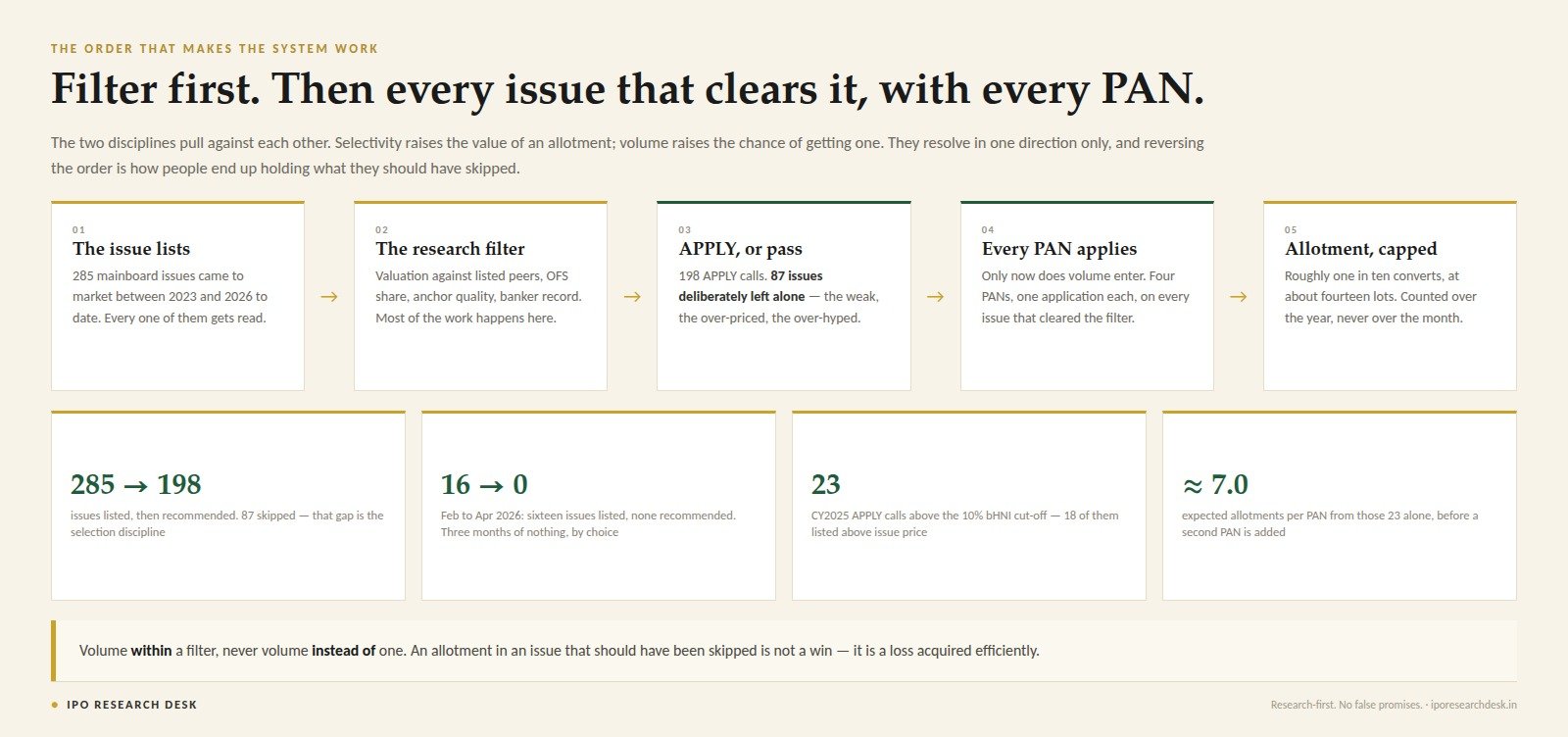
One rule to internalise now, because it causes more rejections than any other: one PAN, one application, per category, per issue. If the same PAN appears twice in the same category, both applications are liable to be rejected. Not one of them. Both. Family members with their own PAN and their own demat account are separate applicants and can each apply — that is entirely ordinary and entirely permitted.
Understand which category you belong to
Your application size decides your category, and the category decides your odds. This is the single most useful table in the whole process.
Retail is the friendliest category for a small applicant, because when an issue is heavily oversubscribed, the retail pool is allotted by lot in minimum lots. Everyone who applies for one lot has the same chance as everyone else applying for one lot. Applying for five lots does not multiply your chances five times in that scenario — it just locks up five times the money.
In a heavily oversubscribed issue, the highest-probability retail application is one lot per PAN across several eligible family PANs. Not five lots from one.
How the money works: ASBA and UPI
You do not pay for an IPO. Your money is blocked. This is the ASBA mechanism, and it is the standard for every mainboard issue.
When you apply, the amount sits in your own bank account, frozen. You continue to earn interest on it. If you receive full allotment, the exact amount is debited. If you receive partial allotment, the balance is released. If you receive nothing, the entire block is lifted and the money was never out of your hands.
Two routes to place the block:
— UPI route — used through your broker's app or website. You enter the bid, a mandate request arrives in your UPI app, and you approve it. Applications up to ₹5,00,000 can go through UPI, which covers all of retail and the smaller end of the HNI category.
— Net banking ASBA — you log into your bank's net banking, go to the IPO section, and place the bid there directly. Necessary for larger applications, and generally the more dependable route when a popular issue is straining broker systems on the closing day.
The mandate matters. A UPI application that is submitted but never approved in the UPI app is not an application. It will not be considered for allotment, and the money will not be blocked. Approve it the moment it arrives, and check that the block reflects in your bank account.
Placing the bid
Four inputs, and one of them trips people up.
— Quantity — always in multiples of the lot size. You cannot apply for an arbitrary number of shares.
— Price — anywhere within the price band, or at cut-off if you are a retail or employee applicant.
— Cut-off — this means you accept whatever final price is discovered, up to the top of the band. Money is blocked at the upper band price and the difference is released later if the final price comes in lower.
— UPI ID or bank details — depending on the route you chose.
Here is the trap. Bidding below the top of the price band, when the issue is well subscribed, will make your application ineligible. The final price will almost certainly be at the top, and any bid below the discovered price is discarded. If you are a retail applicant, bid at cut-off. There is no strategic advantage in bidding lower, and there is a real chance of forfeiting your application entirely.
You may place up to three bids at different price points in a single application. In practice, cut-off does the job for most retail applicants.
The timeline
Mainboard issues run on a compressed calendar. Roughly like this:
allocation
the issue opens
becomes public
by the cut-off time that evening
allotment
unblocking
released
Withdrawal and modification: a retail applicant may revise or withdraw a bid until the issue closes. Once the window shuts, the application is final.
Allotment, and what to do when it does not come
The registrar publishes the basis of allotment, and the status can be checked on the registrar's own website, on the exchange sites, or through your broker. You will need your PAN or application number.
Three outcomes. Full allotment, partial allotment, or none. In an oversubscribed retail category, none is the most common outcome and is not a reflection of anything you did wrong.
If money is not unblocked within a couple of days of the allotment being finalised, raise it with your bank first and your broker second. It is almost always a mechanical delay rather than a lost application.
Listing day
The stock does not simply start trading at the issue price. A special pre-open session runs before normal trading begins, during which orders are collected and an equilibrium opening price is discovered. That discovered price is the listing price, and it may be above, at, or below the issue price.
A price band applies from the first day, which caps how far the stock can move in either direction — a wider band for larger issues, a narrower one for smaller ones. If you intend to sell on listing, understand that a stock locked at its upper limit cannot be bought and a stock locked at its lower limit cannot be sold.
Decide your exit before the pre-open session begins, not while watching the tape. Listing mornings are designed to make you improvise, and improvisation is expensive.
The checklist
— One application per PAN per category. Duplicates get both applications rejected.
— Bid at cut-off if you are retail. Bidding low is not clever.
— Approve the UPI mandate and confirm the block appears in your bank account.
— Do not leave a popular issue to the final hour of the final day.
— For a large application, use net banking ASBA rather than UPI.
— Read the offer document's risk factors. It takes twenty minutes and it is the only section written by lawyers who are obliged to be candid.
DISCLAIMER
The analysis presented herein is based on publicly available information and data as of the date of publication. This content is published for general information and investor education only and does not constitute investment advice or a recommendation to buy or sell any security. Investors should conduct their own due diligence before making investment decisions. Past performance is not indicative of future results and no guarantee of future performance is offered or implied. The publisher does not guarantee the accuracy, completeness, or timeliness of the information provided. Investment in IPOs and equity markets involves substantial risk, including the risk of loss of principal. Market conditions, company performance, regulatory changes, and macroeconomic factors can significantly impact investment outcomes.