
Eleven Things People Believe About IPOs That Simply Are Not True
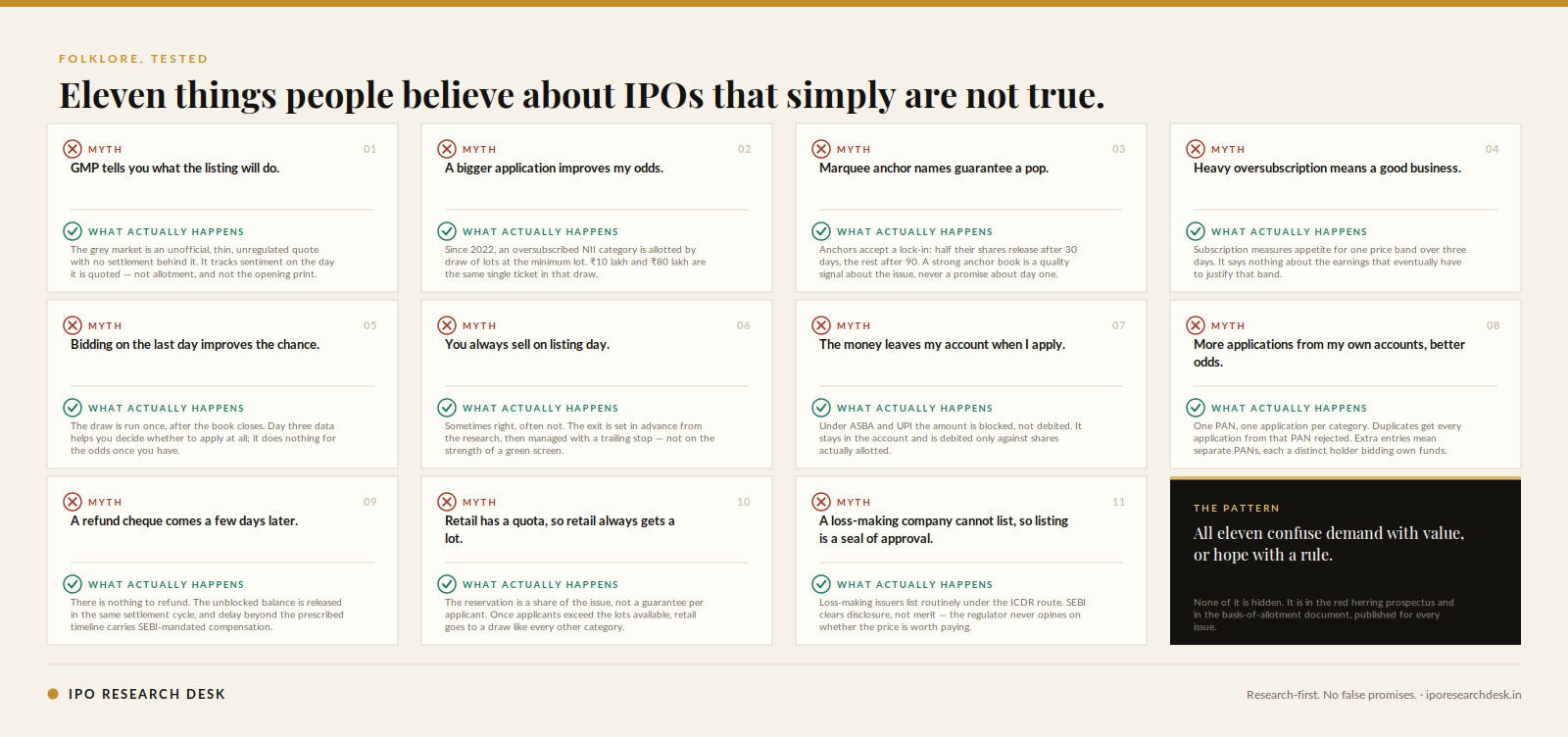

Eleven Things People Believe About IPOs That Simply Are Not True
Most of what circulates about IPOs is folklore repeated confidently. Here is what the mechanics actually say, myth by myth.
The primary market attracts more confident nonsense than any other corner of the Indian market. Some of it is harmless. Some of it costs people real money every listing season. Here are the eleven that come up most often.
Myth 1: A high grey market premium means the stock will list high
The grey market is an unofficial, unregulated, off-exchange market in which a small number of participants trade IPO applications and expected allotments. It has no clearing mechanism, no settlement guarantee and no supervision. The premium is a quote, not a price, and it is quoted by people with a position in it.
Two things follow. First, a grey market premium is thin — the volumes behind those quotes are a rounding error next to the actual issue. Second, it can be talked up. A rising premium in the days before listing is at least as much a marketing input as a forecast.
Treat it as one sentiment indicator among several, and note that it is indicative only. It is not a prediction, and it certainly is not a guarantee.
Myth 2: A hundred times oversubscribed means a hundred times better
Oversubscription tells you how much demand showed up. It says nothing about the price being fair. An issue can be a hundred times covered because the float was tiny, because the lot size was small, or because the marketing was good.
It also cuts against you directly. Heavy oversubscription in retail means allotment goes to a lottery and most applicants get nothing at all. High demand and a good outcome for you are two different things.
Where subscription data does earn its keep is in the split. Demand concentrated in the institutional book, built over the full three days, reads very differently from demand that arrives entirely on the last afternoon in the retail category.
Myth 3: Big-name institutions in the anchor book guarantee a listing gain
It does not. A serious anchor list means professionals with an obligation to their own investors ran the numbers and were willing to buy at that price. That is a genuine positive signal and it is worth weighing.
But anchors are allotted at a fixed price a day before the issue opens, they are subject to a lock-in that releases in stages, and they carry no obligation to support the stock on listing day. Plenty of issues with excellent anchor books have listed flat or below. A strong anchor book does not guarantee listing gains. It never has.
Myth 4: An IPO is a fresh start, so the shares are cheap
There is nothing intrinsically cheap about a new listing. The price band is proposed by the company and its bankers, who know the business better than you do and are trying to raise as much as the market will bear. The offer document contains a peer comparison section for precisely this reason. Read it.
A company asking fifty-five times earnings while its listed peers trade at thirty is not cheap because it is new. It is expensive, and it needs to grow into that number.
Myth 5: A famous brand makes a good IPO
You already know the company, so the investment feels safer. It is not the same thing. Brand recognition tells you the marketing worked. It says nothing about margins, debt, promoter conduct, competitive position or the price you are being asked to pay.
Some of the most heavily marketed listings of recent years have delivered the worst outcomes for people who applied on name recognition alone. The market prices earnings, not familiarity.
Myth 6: Applying for more lots improves your chances
In an oversubscribed retail category, allotment happens in minimum lots by lottery. One lot and five lots receive the same single entry into that draw. You have blocked five times the capital for the same probability.
It works differently in the larger categories, where allotment is proportionate and size does change the outcome. But for a retail applicant in a hot issue, the efficient application is one lot per eligible PAN, spread across the family members who genuinely hold their own demat accounts.
Myth 7: Multiple applications from family accounts are a loophole
Multiple applications from the same PAN are a rejection. Applications from different individuals, each with their own PAN, their own demat account and their own bank account, are simply different applicants. There is nothing irregular about a household applying separately.
What is not permitted is applying more than once under one PAN, or applying in two categories under the same PAN in the same issue. That gets the whole set thrown out.
Myth 8: If the listing goes badly, just hold it long term
This is the most expensive belief on the list, because it converts a small trading loss into a large investment mistake.
If you applied for a listing gain, the thesis was about demand and supply on one particular morning. When that thesis fails, it has failed. Deciding afterwards that you are a long-term holder means you now own a business you never actually researched, at a price you never actually assessed, on a thesis you invented after the fact.
Choose which game you are playing before you apply. Post-hoc conversion from trader to investor is not a strategy — it is loss aversion wearing a suit.
Myth 9: The listing price is the issue price
It is not. The listing price is discovered in a special pre-open session on the morning of listing, and it can open well above or well below the issue price. From there a price band caps movement for the session. Two consequences people learn the hard way: if the stock is locked at the upper band you cannot buy it, and if it is locked at the lower band you cannot sell it.
Myth 10: IPO investing is low risk because it is regulated
Regulation governs disclosure. It requires the company to tell you what could go wrong. It does not vet the price, it does not endorse the business, and it does not protect you from a bad outcome.
The risk factors section of an offer document exists because the issuer is obliged to be candid about what could break. It is the least promotional writing in the entire document, which makes it the most useful. Most applicants have never opened it.
Myth 11: You must apply on the first day, or the last
The day you apply has no effect on your allotment. The lottery does not care. What changes across the three days is your information — by the close of day two you can see how the institutional book is filling, which is real, usable data that day-one applicants do not have.
The one genuine argument against the last hour is operational. Banking and broker systems are stressed on the final afternoon of a popular issue, mandates fail, and an application that does not get blocked in time is not an application.
None of this makes IPOs a bad place to put money. It makes them an ordinary place to put money, which is a more useful thing to believe. The work is the same as it is anywhere else in equities: understand the business, look hard at the price, decide what you are doing and why, and size the position so that being wrong is survivable.
DISCLAIMER
The analysis presented herein is based on publicly available information and data as of the date of publication. This content is published for general information and investor education only and does not constitute investment advice or a recommendation to buy or sell any security. Investors should conduct their own due diligence before making investment decisions. Past performance is not indicative of future results and no guarantee of future performance is offered or implied. The publisher does not guarantee the accuracy, completeness, or timeliness of the information provided. Investment in IPOs and equity markets involves substantial risk, including the risk of loss of principal. Market conditions, company performance, regulatory changes, and macroeconomic factors can significantly impact investment outcomes.